‘The model facilitates an understanding of emotional health and wellbeing, as well as mental health. It can be applied to working with families, with individuals, with groups, with a community or with a large population from a public health perspective.
It can be applied across the age range of a child from preconception to adolescence and across the life trajectory. It has been used in different cultures, in different countries.
It speaks to what it means to be a human being; understanding what supports us in our development and what hinders us. It reminds us of the importance of relationships.’ – Solihull 2018
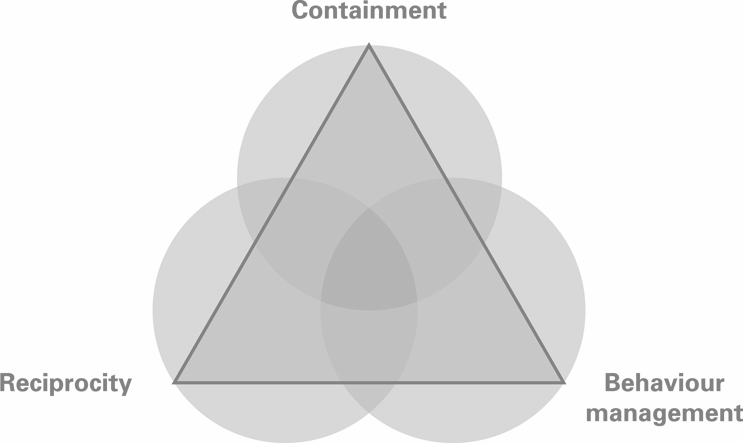
The Solihull Approach model looks at the importance of containment reciprocity and behaviour management in relationships.
What is containment?
Containment is where a person receives and understands the emotional communication of another without being overwhelmed by it and communicates this back to the other person. This process can restore the ability to think in the other person.
What is reciprocity?
Reciprocity describes the sophisticated interaction between a baby and an adult where both are involved in the initiation, regulation and termination of the interaction. Reciprocity can also be used to describe the interaction within all relationships.
What is Behaviour management
Behaviour management is part of the ordinary process of normal development whereby parents teach their child self-control, thus enabling the child to participate in society. Parents in well-functioning families work together to place reasonable boundaries on the child’s behaviour. They encourage the child with attention and other rewards. Gradually, the child becomes able to internalise both the restraints and the satisfactions for himself. It also facilitates learning and development.
The Solihull Approach Parenting Group ‘Understanding your child’s behaviour’ evolved out of using this model of theory and practice over a number of years.
It supports the parent/child relationship by emphasising the need for emotional containment, being part of a reciprocal relationship before we think about behaviour management.
 Families Together